
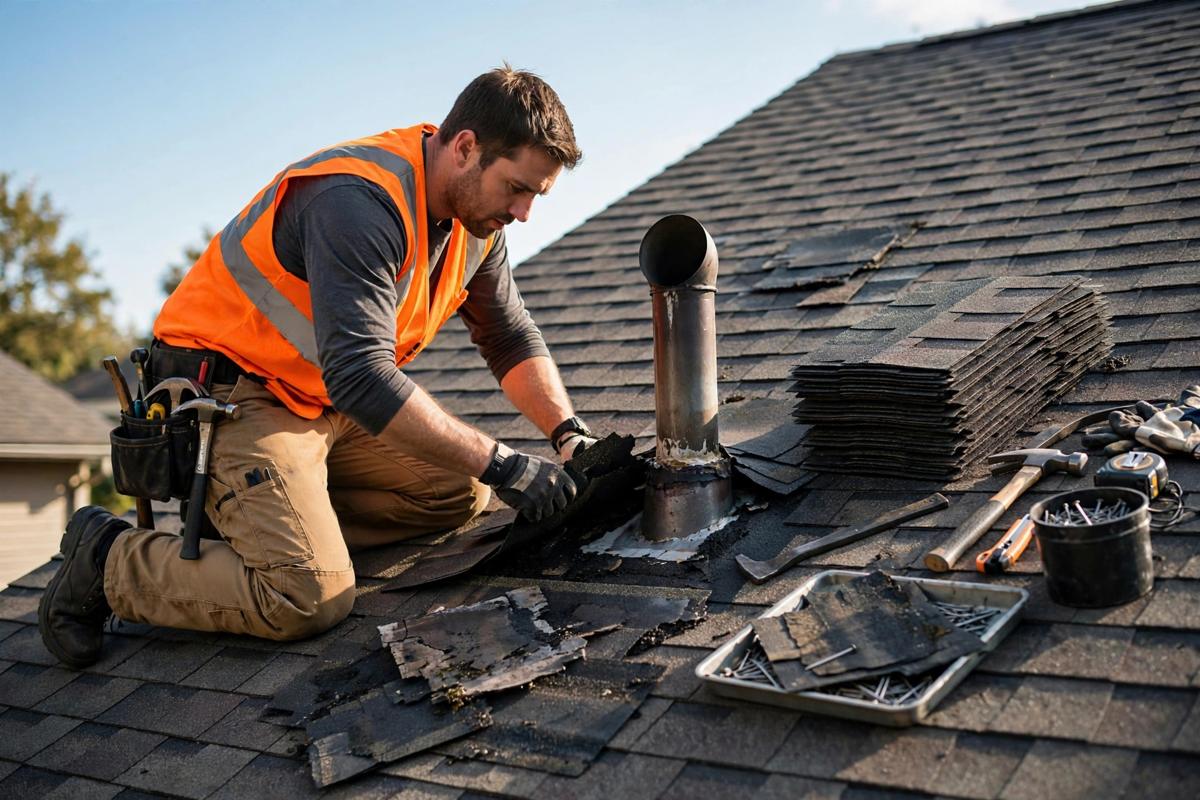
Quick answer: Repair fits limited damage on a sound roof. Replacement fits widespread, recurring or end-of-life problems. Ask for both options priced in writing.
Repair usually makes sense when
- Damage is limited to one area, such as a few lifted shingles, a failed pipe boot or bad flashing.
- The roof is well within its expected life and the decking is solid.
- The leak has a clear, fixable cause.
Replacement deserves a hard look when
- Leaks return after repairs, or new ones keep appearing.
- Wear is widespread: curling, cracking, bare patches or heavy granule loss across several slopes.
- The decking is soft, sagging or water-stained from below.
- Storm damage covers multiple slopes.
- The roof is at or past its expected life. See old roof replacement.
Five questions that settle most cases
- How old is the roof compared with its material's expected life? In East Texas heat, asphalt shingles often age faster than the label suggests.
- How much of the roof is affected? One slope and five slopes are different problems.
- How much have you already spent on repairs? Add up recent invoices. Repeated patching is a pattern.
- What is under the surface? Soft decking changes the answer.
- What are your plans? Selling soon, staying for decades, or planning solar all shift the math.
Do not treat repair as the lesser option
On a sound roof, a well-done repair is often the better value. The goal is an honest match between the work and the roof's condition, not the biggest or smallest job.
A note on matching and warranties
Older shingles can be hard to match, and some repairs may not carry a manufacturer warranty. Ask what the repair is covered by and for how long.
Ask for both options in writing
Request a written assessment that explains the roof's condition, prices a targeted repair and prices a full replacement, with photos. If a contractor will only quote one option, get a second opinion. Start with roof repair or roof inspection.
Educational overview, not a quote, insurance advice or a professional inspection.
Related: Roof Repair Roof Inspection Residential Roof Replacement